Midlife and Aging in Gay America by Douglas Kimmel Dawn Lundy Martin
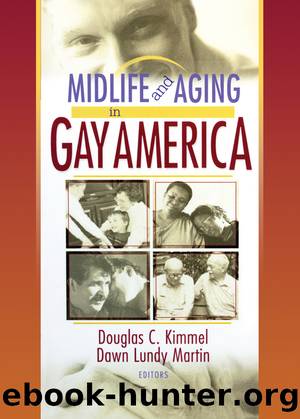
Author:Douglas Kimmel, Dawn Lundy Martin [Douglas Kimmel, Dawn Lundy Martin]
Language: eng
Format: epub
Tags: Social Science, LGBTQ+ Studies, Gay Studies, Gerontology, Social Work, Sociology, General, Gender Studies
ISBN: 9781317992608
Google: GDzJBQAAQBAJ
Publisher: Routledge
Published: 2014-01-02T04:56:58+00:00
What About AIDS? What Effect Has It Had on Older Gay Men?
In the United States and the rest of the Western world, the AIDS epidemic has had a disproportionate effect on gay men. (The situation is different in much of the developing world.) Gay men have felt the impact in two ways. Those infected with the virus have had to face a devastating chronic illness and issues of premature mortality. In addition, until the recent development of effective drug therapies, many gay men have had to face multiple deaths of friends, colleagues, and family members. Many of those who fell ill during the 1980s were gay men in their thirties and forties. Those who survived are now in their forties, fifties, and sixties. These men face the multiple challenges of growing older and coping with chronic illness. As more effective therapies are developed, this situation may change.
A Strengths Perspective
It may surprise some to learn that there are aspects of the gay experience that may make it easier for a man to adapt to the aging process. Here is an analogy from medicine. Traditionally, doctors advise allergic people to avoid all allergens. (Think of allergens as naturally occurring âeventsâ that are part of living: dust, molds, foods. Even less than optimal temperatures may be allergens.) But recent medical evidence indicates that allergensâthat is, challenges to our immune systemâare a necessary part of our biology; they serve to âtweakâ our immune systems, keeping them in optimal condition. Unchallenged and unused, our immune systems, like our muscles, will atrophy. Thus, what seemed at first to be a disadvantage, is in fact an advantage.
One might think of people who face minority experiences in a parallel way. Their experiences are, in part, a result of growing up and growing older as a member of a despised group. A lifetime of facing and overcoming the challenges (âallergensâ) of low self-esteem, discrimination, and oppression, strengthens rather than weakens.
How does this apply to older gay men? Included here are two factors that have been cited as helping gay men to face the challenges of growing older.
The first one may be called mastery of stigma. One of the great difficulties for all older people in Western cultures is that aging is stigmatized and aged people are devalued. Gay peopleâand no doubt members of other oppressed groupsâhave a unique advantage. In their adolescence and young adulthood, gay men had to learn how to manage the stigma of being gay. They had to salvage their self-esteem, for example, in the face of societal disapproval. Most gay people do this successfully. It is suggested here that when, in later life, they must face the stigma of being old, they are in a better position to adapt than their heterosexual counterparts. They have already had a successful mastery of stigma experience.
A similar phenomenon is what might be called a crisis of independence. Again, experiences early in the lives of gay men may prepare them for a more successful adaptation to old age. Heterosexual
Download
This site does not store any files on its server. We only index and link to content provided by other sites. Please contact the content providers to delete copyright contents if any and email us, we'll remove relevant links or contents immediately.
| Anthropology | Archaeology |
| Philosophy | Politics & Government |
| Social Sciences | Sociology |
| Women's Studies |
Cecilia; Or, Memoirs of an Heiress — Volume 1 by Fanny Burney(32562)
The Great Music City by Andrea Baker(32023)
Cecilia; Or, Memoirs of an Heiress — Volume 2 by Fanny Burney(31959)
Cecilia; Or, Memoirs of an Heiress — Volume 3 by Fanny Burney(31945)
We're Going to Need More Wine by Gabrielle Union(19053)
All the Missing Girls by Megan Miranda(16050)
Pimp by Iceberg Slim(14522)
For the Love of Europe by Rick Steves(14174)
Bombshells: Glamour Girls of a Lifetime by Sullivan Steve(14081)
Norse Mythology by Gaiman Neil(13376)
Talking to Strangers by Malcolm Gladwell(13376)
Fifty Shades Freed by E L James(13247)
Mindhunter: Inside the FBI's Elite Serial Crime Unit by John E. Douglas & Mark Olshaker(9347)
Crazy Rich Asians by Kevin Kwan(9297)
The Lost Art of Listening by Michael P. Nichols(7509)
Enlightenment Now: The Case for Reason, Science, Humanism, and Progress by Steven Pinker(7316)
The Four Agreements by Don Miguel Ruiz(6770)
Bad Blood by John Carreyrou(6626)
Weapons of Math Destruction by Cathy O'Neil(6284)
